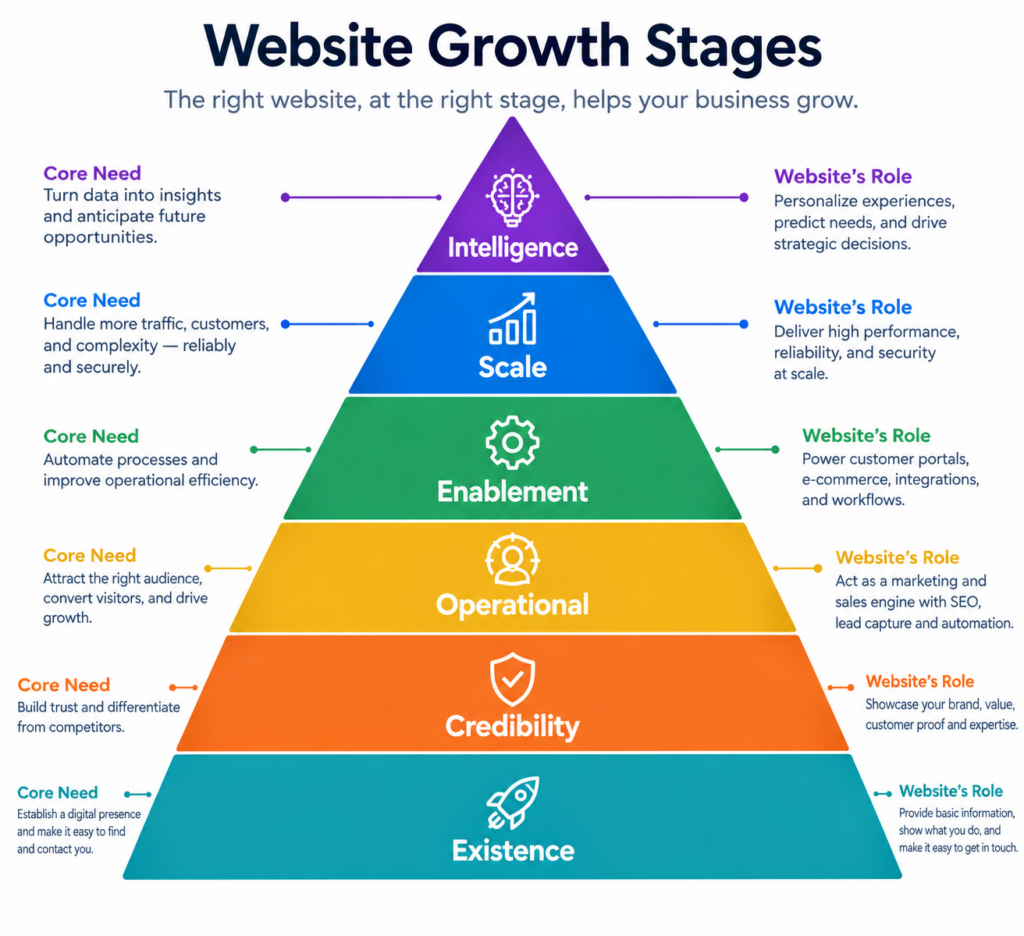
Get the Most from Your Website with Growth Stages
A website is the foundation of a business’s digital presence, marketing, sales, and customer experience. As a business grows, its website needs to grow as well. We have grouped the needs of websites into distinct Growth Stages, each with its own technical needs and opportunities.
Understanding the stage your business is in and aligning your website with the corresponding website Growth Stage can help you avoid overbuilding too early, falling behind as you grow, or investing in technology that doesn’t actually support your goals. DataFiend helps businesses evaluate where their website is now, understand where they need it to be next, and build the technology necessary to enable the transition.
Website Growth Stages
Can people find us and understand what we do?
For most businesses, their first website is about establishing a digital presence. At this stage, your website serves to make sure people can find your business, understand what you do, and know how to get in touch. The focus is on creating a professional, functional foundation without investing in technology the business isn’t ready to use. A simple, well-built website can provide everything a new business needs to establish credibility online and begin attracting initial customers.
Websites at this Growth Stage should have all of these features
- Domain and hosting
- Basic website
- Mobile responsiveness
- Basic SEO
- Google Business Profile
- SSL/security
- Basic branding
- Contact information
- Contact form
- Analytics
Can the website turn visitors into leads?
Once a business has established itself and begun attracting customers, its website needs to build confidence in the product / service. At this stage, the website becomes an important part of the sales process, helping potential customers understand why they should choose your business over the competition. This means adding stronger branding, customer testimonials, case studies, valuable content, better user experiences, and the tools necessary to capture and manage leads. The goal is to turn a basic online presence into a website that actively supports the business’s reputation and sales efforts.
Websites at this Growth Stage should have all of these features
- Professional CMS
- Better UX/UI
- Case studies
- Testimonials/reviews
- Blog/content marketing
- Lead forms
- Email marketing integration
- CRM integration
- Conversion tracking
- Search Console
- More sophisticated SEO
- Landing pages
How do we systematically turn traffic into revenue?
As a business begins focusing on consistent growth, its website needs to become a powerful customer acquisition engine. At this stage, the focus shifts toward attracting the right audiences, converting visitors into leads, and understanding which marketing activities are producing results. The website isn’t simply supporting marketing; it is becoming an pivotal part of the company’s growth strategy.
Websites at this Growth Stage should have all of these features
- Marketing automation
- Advanced SEO
- Audience segmentation
- Retargeting
- CRM automation
- Lead scoring
- Conversion optimization
- Multiple landing-page experiences
- Campaign-specific pages
- Advanced analytics
- Data layer/GTM implementation
- Integrations with advertising platforms
- A/B testing
What business processes can technology automate?
Some businesses reach a point where their website needs to expand beyond attracting and converting customers to helping the business operate. At this stage, the website begins taking on functions traditionally handled by employees, separate software, or manual processes. Customer portals, online payments, scheduling, e-commerce, advanced forms, integrations, automated workflows, and custom applications can all become part of the website ecosystem. The goal is to use technology to eliminate repetitive work, connect systems, and make the business more efficient.
Websites at this Growth Stage should have all of these features
- Customer/member portals
- Account management
- Online payments
- Scheduling
- E-commerce
- Advanced forms/workflows
- APIs
- Database integration
- CRM synchronization
- Marketing automation
- Customer data platform
- Automated notifications
- Personalized content
- Internal dashboards
- Multiple systems sharing data
Can our technology handle the business we are becoming?
Growth creates new technical challenges. A website that performed well for a few hundred visitors may struggle with thousands or millions, and a collection of simple integrations can become increasingly difficult to manage as a company expands. At this stage, the focus shifts toward performance, reliability, security, infrastructure, and architecture. Websites and applications need to be designed to handle greater traffic, more customers, more data, and more complex business processes without sacrificing speed or reliability. The goal is to build a digital foundation that can support the size of business you are becoming.
Websites at this Growth Stage should have all of these features
- Scalable infrastructure
- Advanced hosting/cloud architecture
- CDN
- Performance optimization
- Caching
- Advanced security
- Automated backups
- Disaster recovery
- Monitoring
- SSL/security
- High availability
- API architecture
- Data pipelines
- ETL
- Cross-platform data syncing
- Advanced analytics
- Enterprise CRM/CDP
- Multiple websites/subdomains
How do we use technology and data to make better business decisions?
At this stage, the website becomes part of a broader intelligent digital ecosystem. Instead of simply responding to customers and employees, technology can begin using data to anticipate needs, personalize experiences, identify opportunities, and improve performance. Advanced analytics, customer data, artificial intelligence, personalization, predictive technologies, and automated decision-making can transform the website from a business tool into a source of competitive advantage.
Websites at this Growth Stage should have all of these features
- Unified customer data
- Advanced attribution
- Predictive analytics
- Personalization
- AI-driven experiences
- Automated decision-making
- Experimentation platforms
- Real-time dashboards
- Advanced segmentation
- Data warehouses
- Business intelligence
- Machine-learning integrations
- Enterprise security
- Governance
- Accessibility at scale
- Multi-brand/multi-site architecture