
Today, having an internet presence is important for almost every business. Potential customers often turn to the internet to learn about a company, find contact information, research products and services, and decide whether a business is worth their time. But for a early-stage businesses, or even ideas that haven’t become a full-fledged business yet, building and maintaining an entire website may be unnecessary. If you’re still testing an idea, building your customer base, or figuring out exactly what your business will become, spending significant time and money on a website may not be the best use of your resources.
Fortunately, a website isn’t the only way to establish an online presence. Several existing platforms can provide many of the basic functions a new business needs without requiring you to purchase a domain, set up hosting, design pages, and manage a website. These options can help you establish credibility, make your business easier to find, communicate with customers, and even generate sales while you determine whether and when a full website makes sense.
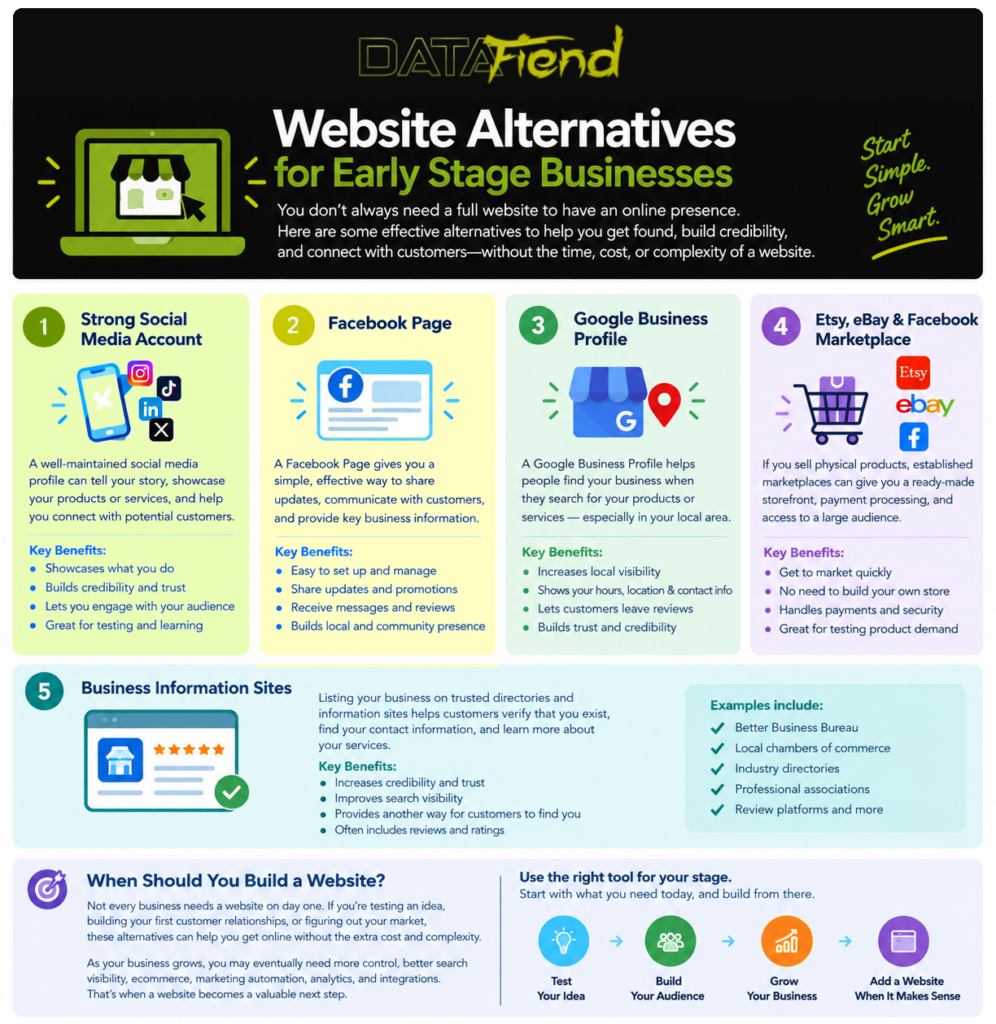
A strong social media presence can be a powerful substitute for a website. A well-maintained business profile can tell potential customers who you are, what you offer, where you’re located, and how they can get in touch with you. Depending on the platform and type of business, you may also be able to showcase products, collect inquiries, share customer reviews, and direct people to make a purchase or schedule an appointment.
The key word here is strong. Simply creating an account and leaving it mostly empty doesn’t provide much value. Your profile should be complete, professionally presented, and regularly updated. Use a recognizable business name and profile image, write a clear description of what you offer, provide contact information, and post content that demonstrates that your business is active. Potential customers should be able to visit your profile and quickly understand what your business does.
A social media presence can be particularly useful while you’re testing a new business concept.
Instead of investing heavily in a website before you know what customers want, you can use social media to experiment with messaging, products, content, and offers. As the business develops and your needs become more sophisticated, you can eventually add a website and use your social accounts to drive traffic to it.
A Facebook Page can provide an especially easy starting point for businesses that aren’t ready for a website. A business page can provide basic information about your company, including its name, description, location, hours, contact information, photos, services, and other details. Customers can also interact with your business directly through Facebook rather than having to leave the platform.
Facebook can be particularly useful for businesses that rely heavily on local customers or personal relationships. A business can post updates, announce promotions, share photos of its work, answer questions, and interact with customers through comments and messages. With enough activity, this can provide enough of an online presence during the earliest stages of growth.
A Facebook Page also gives you a place to establish your business identity before investing in a full website. However, remember that you’re building your presence on someone else’s platform. Facebook controls the platform, its features, and how your content is displayed. As your business grows, having a website that you control can give you considerably more flexibility and ownership over your online presence.
For businesses that serve customers in a particular geographic area, a Google Business Profile can be one of the most valuable online assets you can establish early on. It can help people find your business when they search for your company or for products and services you provide. Your profile can include your business name, location, hours, phone number, photos, reviews, website link, and other important information.
This can be especially important for businesses where customers are likely to search for something like “plumber near me,” “coffee shop,” “landscaper,” or another local service. A complete and accurate profile gives potential customers a way to learn about your business without necessarily needing to visit a separate website. Reviews and photos can also provide valuable social proof when someone is deciding whether to contact you.
Keeping your profile accurate is important. Make sure your hours, phone number, address, service information, and other details are current. Encourage legitimate customers to leave reviews and respond appropriately to questions or feedback. Even after you eventually build a website, your Google Business Profile can remain an important part of your overall online presence.
If your early-stage business sells physical products, you may not need to build an ecommerce website immediately. Platforms such as Etsy, eBay, and Facebook Marketplace already provide much of the infrastructure required to list products and connect with potential buyers. Instead of building a product catalog, shopping cart, payment system, and checkout process yourself, you can use an established marketplace to get your products in front of customers.
This can be particularly useful when you’re testing whether people will actually buy your products. Rather than spending thousands of dollars building an ecommerce site before you’ve made your first sale, you can start with a marketplace, learn which products customers respond to, and refine your business model. The marketplace can effectively provide the storefront while you concentrate on your products, customers, fulfillment, and marketing.
There are tradeoffs, however. Marketplaces generally charge fees, have their own rules, and give you less control over the customer experience than you would have with your own website. You’re also competing with other sellers on the same platform. As your ecommerce business grows, you may eventually want your own online store so you have greater control over branding, customer relationships, marketing, and the overall buying experience. But when you’re just getting started, an established marketplace can be a practical way to test the waters.
Another way to establish an online presence is by creating profiles on established business and information websites. Depending on your industry and location, this can include organizations such as the Better Business Bureau, local chambers of commerce, industry directories, professional associations, review platforms, and other business listing services.
These profiles can provide basic information about your company and give potential customers another way to verify that your business exists. Some platforms also provide opportunities to collect reviews, display contact information, describe your services, and link to your other online profiles. Being represented consistently across reputable platforms can also help create a more complete picture of your business online.
As with social media and marketplace platforms, it’s important to remember that these aren’t replacements for owning your own digital presence forever. You don’t control these platforms, and their policies and features can change. But for a business in its earliest stages, establishing accurate and consistent profiles across relevant platforms can be a relatively inexpensive way to start building an online footprint before investing in a full website.
Not every business needs a website on day one. If you’re still validating your idea, building your first customer relationships, or trying to determine whether your business has a viable market, using existing platforms can be a smart way to establish an online presence without taking on unnecessary technology and expense.
Though, your business may outgrow these alternatives eventually. You may need more control over your brand, better search visibility, more sophisticated lead generation, ecommerce functionality, customer portals, marketing automation, analytics, or integrations with other business systems. That’s when a website can move from being an optional expense to an important business tool.
The important thing is to build technology around the needs of your business—not simply because every other business has a website. Start with the online presence that makes sense for where you are today, learn from your customers, and invest in a website when it can provide meaningful value to the next stage of your growth.
For more guidance on when you may need a website and all the benefits a website can add to your business, check out our Website Growth Stages resource page.